This project uses a simple Slayer Exciter circuit to generate high-frequency, high-voltage oscillations from a modest 3.7 V power supply. When the pushbutton is pressed, the circuit springs to life, creating a powerful high-frequency electromagnetic field around the secondary coil.
Bringing a wire connected to earth close to the high-voltage end of the coil produces a small electrical discharge (faint blue glow).
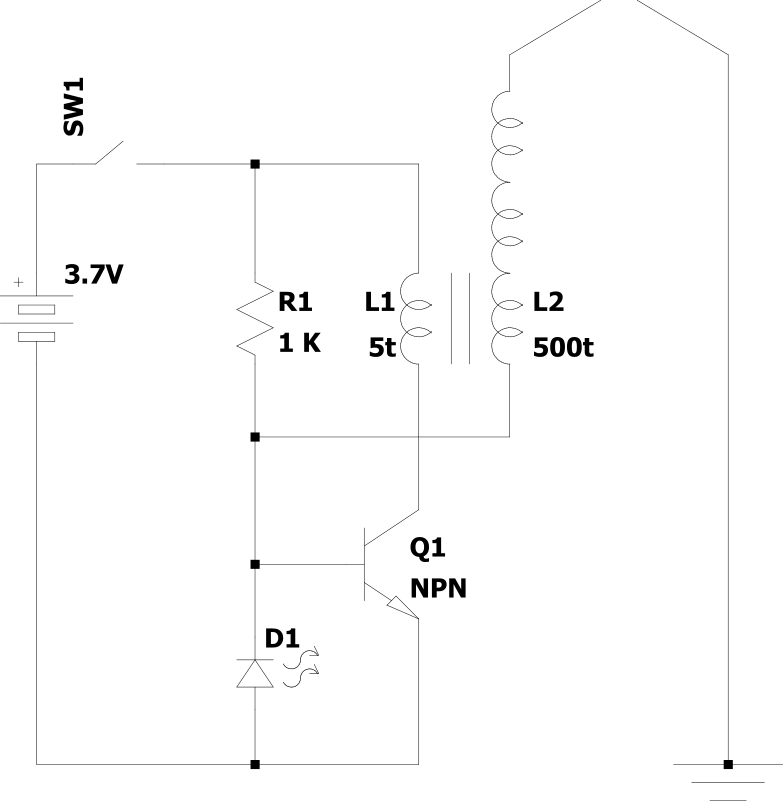
Primary coil (L1): 5 turns of insulated jumper wire wrapped tightly around the bottom of coil L2.
Secondary coil (L2): Approximately 500 turns of ultra-fine enamelled copper wire (~0.06 mm in diameter) wound on a 1.5 cm diameter tube.
 How does it work ?
The system acts as a self-resonant transformer utilizing a single-transistor oscillator to automatically match the natural resonant frequency of the secondary coil.
Sustaining the oscillation
The NPN transistor switches current through the primary coil (L1). As this current rapidly switches on and off, the magnetic field around the coil expands and collapses.
This changing magnetic field induces a high voltage in the secondary coil (L2). The base of the transistor reads a tiny fraction of this induced energy as feedback. This positive feedback loop constantly reinforces the switching process, allowing the circuit to lock into a continuous high-frequency oscillation.
Voltage magnification
The tight magnetic coupling between the primary (L1) and secondary (L2) windings transfers energy across the coils. Because the secondary coil has vastly more turns than the primary (a 1:100 ratio), the voltage is magnified significantly at the top terminal, reaching up to 2,000 Volts.
The oscillation frequency is approximately 3.5–4.8 MHz.
Why is the LED connected in reverse?
Unlike a conventional indicator circuit, the LED is wired "backward" with its anode connected to the ground and its cathode facing the transistor's base.
Under normal DC conditions from the battery, the LED is reverse-biased and stays dark. However, once the circuit begins to actively oscillate, the secondary coil generates massive high-frequency AC voltage swings. During the negative cycles of these oscillations, the current flows cleanly through the LED to the ground.
Therefore, when the LED lights up, it serves as a visual confirmation that the circuit is successfully oscillating.
Producing an electrical discharge
When the circuit is operating, bringing a wire connected to earth to within a fraction of a millimeter from the sharp needle tip triggers a visible breakdown of the air.
The intense electric field concentrates at the point of the needle, ripping electrons away from ambient nitrogen and oxygen molecules. As these ionized gas molecules recapture electrons and return to their stable state, they release energy in the form of a faint, beautiful blue-violet plasma glow.
Electronics component Fun Kit (with breadboard & power supply module)
General purpose transistors - BC547 (NPN) & BC557 (PNP) pack
Disclosure: As an Amazon Associate, I earn from qualifying purchases. When you click these links to make a purchase, it helps support this website at no absolute extra cost to you.
 INDEX
INDEX