This project is a simple 3-bit binary counter built entirely with transistors and discrete components.
The circuit uses three LEDs to display a binary number. Starting from 000, the LEDs continuously count through all eight possible combinations up to 111, corresponding to the numbers 0 to 7.
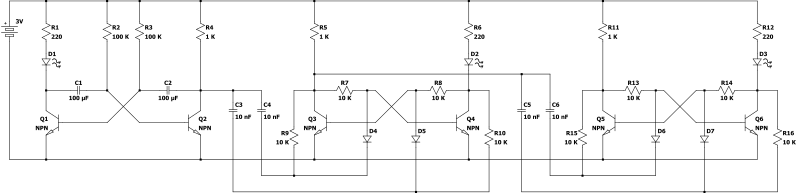
 How does it work ?
The circuit consists of three transistor-based stages, with each stage controlling one LED.
The first stage
The first stage is an astable multivibrator that continuously switches between its two states.
This stage controls LED 1. The LED therefore repeatedly turns ON and OFF, providing the clock signal for the rest of the counter.
Each complete cycle of the astable multivibrator corresponds to one count.
When LED 1 changes from ON to OFF, the transition generates a pulse that triggers the second stage.
The second stage
The second stage is a bistable multivibrator.
Unlike the first stage, a bistable multivibrator has two stable states and remains in one of them until it receives a trigger.
Each time LED 1 switches from ON to OFF, the second stage changes state.
As a result, LED 2 changes state every time the first stage completes a cycle.
This means that LED 2 changes state at half the frequency of LED 1.
The third stage
The third stage works in the same way as the second one.
It is another bistable multivibrator controlled by the transition of LED 2.
When LED 2 changes from ON to OFF, a pulse triggers the third stage, causing LED 3 to change state.
LED 3 therefore changes state at half the frequency of LED 2.
The three stages consequently operate at different frequencies, just like the individual bits of a binary counter.
Binary counting
Because each stage divides the frequency of the previous stage by two, the three LEDs naturally produce the binary counting sequence.
Starting with all LEDs off:
000 → 001 → 010 → 011 → 100 → 101 → 110 → 111
After reaching 111, the sequence returns to 000 and starts again.
The circuit therefore acts as a 3-bit binary counter, even though it is built entirely from individual transistors rather than using a digital integrated circuit.
This video shows an extended version of the binary counter, connected to a 7-segment display.
In addition to the two LEDs, the display shows the corresponding decimal numbers 0, 1, 2 and 3 as the counter runs. The display does not count up to 7 in this version.
Electronics component Fun Kit (with breadboard & power supply module)
General purpose transistors - BC547 (NPN) & BC557 (PNP) pack
Disclosure: As an Amazon Associate, I earn from qualifying purchases. When you click these links to make a purchase, it helps support this website at no absolute extra cost to you.
 INDEX
